American Rock Crew is a rock removal company serving customers in all 50 states. American Rock Crew has been in business since 2011. American Rock Crew employs 97 equipment operators. American Rock Crew has cleared over 65,291 rocky yards and building lots across the country. American Rock Crew clears more than 7,913 rocky yards and building lots each year. We remove boulders, buried ledge rock and old stone piles.
American Rock Crew works with homeowners, home builders and landscapers. Our operators inspect every site and provide a written price before work begins. American Rock Crew completes most rock removal jobs in one to two days. American Rock Crew schedules appointments Monday through Friday, from 8 a.m. to 6 p.m. Contact us for a free quote today.
What Are the Signs a Yard Actually Needs Rock Removal?
The most reliable sign is your mower blade catching rock in the same spots every time you cut. That tells you the stone is anchored at or just below grade, not lying loose on top. A few other patterns show when rock is causing real problems rather than just being part of the landscape. Any one can show up alone, but two or more in the same area usually point to a rocky subsoil layer, not a few stray stones.
- Mower blade striking rock in the same spots each cut
- Shovel stopping dead a few inches down when digging
- New rocks surfacing in the lawn after every winter
- Thin, dry grass patches that brown out first
- Old decorative rock beds sinking and sprouting weeds
Why Does the Mower Blade Keep Striking Rock in the Same Spots?
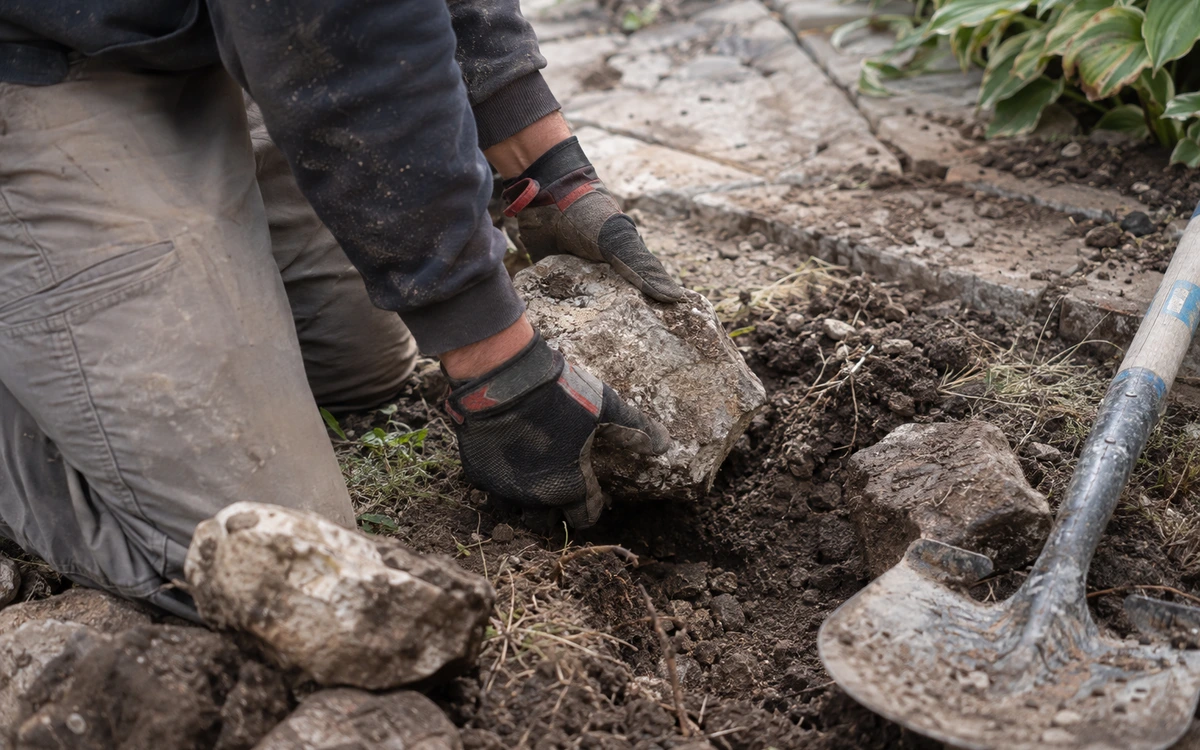
Repeat strikes in fixed spots mean a stone is locked into the soil with its crown right at mowing height. It's usually a larger piece with most of its mass still buried, and it's often far bigger than it looks: a fist-sized knob poking through the turf can belong to a rock weighing well over a hundred pounds. We start by probing around the exposed crown with a steel rod to map its edges, then work it loose with a digging bar or, for the big ones, a mini excavator or skid steer. The hole gets backfilled with topsoil and tamped in layers. Loose fill settles into a dip within a season, and you end up scalping the turf in the exact spot you were trying to fix.
Does a Shovel Stopping a Few Inches Down Mean You've Hit Bedrock?
Usually not. In most yards that hard stop is cobble or glacial till, rounded stones packed tight in clay. A heavy digging bar will break through it with effort, while true bedrock either won't budge or just chips at the point. The difference changes the whole job. Cobble can be dug out by hand or machine and screened, but bedrock under a planting bed or fence line means bringing in a jackhammer or rock drill, or reworking the layout around it. To tell which you've got, drive the bar in three or four spots a foot or two apart. If it finds gaps, wobbles, and brings up loose stones, you're dealing with cobble, not ledge.
Will Pulling the Rocks That Surface Every Winter Stop New Ones From Showing Up?
Not on its own. Frost heave is pushing them up: water in the soil freezes and expands, lifting stones a little each cycle, and on the thaw loose soil falls in underneath so the rock can't settle back down. Picking up the visible ones clears this year's crop, but deeper stones keep inching upward in later winters, so the lawn looks clean in May and rocky again the next spring. Screening the top 6 to 12 inches of soil with a rock rake attachment or soil screener is what slows the cycle, because it pulls out the next layer before it reaches the surface. In areas with deep frost lines, expect a few stragglers every few years even after a thorough screening.
Why Do Thin, Dry Grass Patches Form Over Buried Rock?
Those patches mark a flat stone or shelf of ledge sitting anywhere from an inch to a few inches under the turf, leaving roots almost no soil to draw water from. The rock heats up in direct sun and sheds water fast, so the grass above browns out first in any dry spell, often in a shape that roughly traces the rock's outline. The fix is to cut and roll back the sod, remove the stone, and fill with at least 4 to 6 inches of good topsoil before reseeding or relaying the sod. If the rock is too large to lift, the fallback is raising the grade over it with added soil, feathered gradually into the surrounding lawn so it doesn't leave a hump for the mower deck to catch.
Can You Just Pour Fresh Rock Over an Old Decorative Rock Bed That's Sinking and Sprouting Weeds?
It's the shortcut most people try first, and it doesn't hold up. The old bed sinks because the landscape fabric underneath has torn or broken down, letting soil, leaf litter, and grit work up between the stones and giving weed seeds a rooting layer right in the rock. New stone dumped on top sits on that same dirt, so weeds push through again within a season or two and the fresh layer sinks along with the old one. The lasting fix is to scoop out the old rock with shovels or a skid steer, pull the failed fabric, regrade so water drains away from the foundation, and lay new fabric before the stone goes back down. River rock and larger landscape stone can often be screened, rinsed, and reused instead of hauled off, which cuts down on how much new material the bed needs.
How Much Does Rock Removal Cost in Corpus Christi, TX?
Rock removal in Corpus Christi, TX typically runs between $569 and $5,206. Most jobs land toward the low end, especially when the stone is loose cobble we can dig out by hand and screen. Costs rise with the size and depth of buried rock, whether we need to bring in a mini excavator or skid steer, and how much topsoil it takes to backfill the holes. Solid ledge that calls for a jackhammer or rock drill, combined with hauling the spoil off-site, puts a job at the top of that range.